How to Become the Name People Remember
Close the Recall Gap by connecting your expertise to the problems people need solved.
A potential client could hear about you tomorrow. Not through LinkedIn, your website, or an advertisement.
Someone mentions a problem. Another person remembers your name. And a conversation begins.
You may never know how that recommendation happened.
I've become increasingly interested in these invisible moments. When I started writing on LinkedIn in January 2022, I believed visibility was the answer. I wrote every day for 664 days, hoping that more people seeing my work would create more opportunities.
It certainly helped me become known. But as I worked with more founders, consultants, and senior professionals, another question became important.
What happens after someone has seen your work?
Will they remember you when that knowledge becomes useful?
That question led me to one of the four parts of my Authority Gap framework.
I call it the Recall Gap.
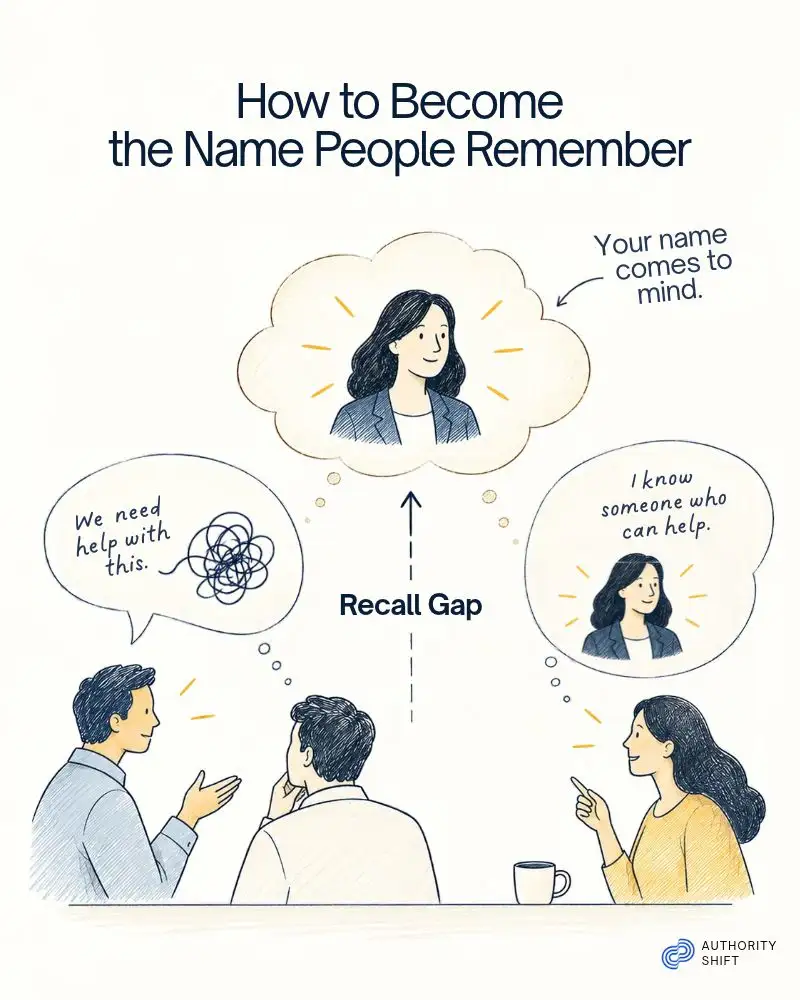
Being known and being remembered are different
The Recall Gap is the distance between people knowing your name and expertise, and remembering you without prompting when a relevant problem, referral, or opportunity appears.
It's the third part of the Authority Gap, after Recognition and Association, and before Choice.
Imagine a leadership coach who helps founders build teams that can make decisions independently.
A former colleague knows her. They've read her posts and respect her work.
Months later, a founder tells that colleague:
"My company has doubled in size. But I still approve almost everything. I can't even take a week off."
Will the coach's name come to mind? Perhaps. But it depends partly on what the colleague remembers about her.
The coach's experience may be excellent. Yet if the colleague only remembers her as a general leadership coach, the connection might be less immediate.
Now imagine the colleague remembers a story she shared about helping a founder solve this exact problem. That gives the mind something specific to work with.
There is an important distinction here. The Association Gap concerns what people connect with your name. The Recall Gap concerns whether your name comes to mind when that expertise is needed.
Why certain problems bring names to mind
There's an interesting connection to marketing research here.
Researchers at the Ehrenberg-Bass Institute study how buying situations bring particular brands to mind. They call these situations Category Entry Points.1
Their research describes Category Entry Points as the thoughts and situations that arise when buyers begin considering a category. A brand's mental availability depends partly on how readily it comes to mind in those buying situations.
The original research concerns brands and buying behavior. Applying this principle to the reputations of individual experts is my interpretation.
But I think it's a useful one.
Consider the difference between remembering someone as a leadership coach and remembering that same person when a founder says, "My managers can't make decisions without me."
The second situation creates a more specific connection between a problem and the expert who can help.
The goal is to connect your name with the problems you want to be known for solving.
That brings us to a practical way to begin.
Build your Recall Trigger Map
I call this exercise the Recall Trigger Map.
A Recall Trigger Map is a simple way to connect three things: the situations in which you want people to remember you, real examples that demonstrate your expertise, and the places where relevant people encounter those examples.
Take a sheet of paper and divide it into three columns.
- The moment — What problem makes your help useful?
- Your proof — What real work shows you can help?
- Where people hear it — Where can relevant people encounter that story?
Let's complete one together.
1. Describe the moment, not your service
Our leadership coach could say, "I help founders build better leadership teams."
That's clear. But many coaches offer something similar.
Now consider: "When a founder cannot take a week off because every decision depends on them."
You can picture that situation immediately. It has a problem, a cost, and a reason someone might seek help.
A second moment might be when a management team constantly waits for the CEO to settle disagreements. A third might be when the company keeps hiring managers, but the founder's workload never seems to shrink.
All three situations point toward related expertise, but each gives a different person a reason to remember it.
Start with three situations like these. Choose moments connected to work you genuinely want more of.
2. Find proof that makes the connection believable
Suppose our coach helped a founder whose managers kept asking for approval.
She noticed something the founder had missed. The managers were capable, but nobody had agreed which decisions they could make independently.
She helped clarify those responsibilities.
That's the kind of example worth sharing, provided it reflects real work. It shows the problem, her judgment, and the help she provided.
The next time someone hears about a founder struggling with delegation, that story may help bring her to mind.
A useful story gives people more than information. It gives them something to remember you by.
If you're unsure which examples to use, revisit your Proof Bank. Look for decisions, results, and situations that support the work you want next.
Not every example needs an impressive number or a famous client. Sometimes, a decision you made or a problem you noticed demonstrates your judgment more clearly than a list of achievements.
3. Make the connection visible
Now think about where the people who could recommend you already encounter your work.
It might be LinkedIn, a newsletter, a podcast, an industry event, or a conversation with an old client.
Our coach could share different stories over time. One about founders struggling to delegate. Another about managers waiting for approval. A third about building a team that can function without the founder.
Different lessons, with one common connection.
Her name repeatedly appears alongside the problems she helps solve.
This doesn't require publishing the same message every week. It requires making a consistent part of her expertise easier to recognize and remember.
And it doesn't require a huge audience, either.
In my article on the Decision Network, I explore why the people who can create, influence, or introduce you to an opportunity may matter more than your total audience size.
That is worth considering when deciding where to share your work.
What a Recall Trigger Map can and cannot do
A Recall Trigger Map helps you decide which situations to associate with your professional reputation, what proof supports those associations, and where to communicate them.
It's a starting point for building stronger recall. Completing the exercise doesn't establish that people already remember you in those situations.
Nor does being remembered guarantee you'll be chosen. Someone may recall your name but still need more information about your experience, approach, availability, or suitability.
That is the Choice Gap, the fourth part of the Authority Gap.
The distinction matters because visibility, association, recall, and choice require different kinds of attention.
Now make it your own
Complete your Recall Trigger Map with three situations. For each, identify one real example and one place where the right people could encounter it.
Then choose one situation to write or speak about this week.
That's your starting point.
Over time, pay attention to the language people use when they introduce or recommend you. Do their descriptions connect your name with the situations you've identified? Their answers can help you understand how your reputation is being carried into other conversations.
Your best opportunities may begin in conversations you're not part of.
Give people a useful reason to remember you when those conversations happen.
Frequently asked questions
What is the Recall Gap in authority branding?
The Recall Gap is the difference between people knowing who you are and remembering you when a relevant need appears. Someone may understand and respect your expertise without spontaneously thinking of you when asked for a recommendation.
How can I become the expert people remember and recommend?
Start by identifying specific situations in which your expertise is valuable. Connect those situations to real examples of your work, then share those examples consistently where potential clients and referrers are likely to encounter them.
Is the Recall Gap the same as the Association Gap?
No. The Association Gap concerns what people know you for. The Recall Gap concerns whether they remember you when that expertise becomes relevant. Someone can know what you do and still fail to think of your name at the right moment.
Do I need a large LinkedIn audience to improve professional recall?
Not necessarily. The relevance of the audience matters. A smaller group of clients, colleagues, industry peers, and potential referrers may be particularly useful when those people influence the opportunities you want.
Want help building your authority brand? Book an Authority Clarity Call.
Get the Authority Shift Letter. Every Saturday, receive one practical idea to help turn your expertise into recognition, trust, and better opportunities. Subscribe free.
Research and further reading
- Ehrenberg-Bass Institute for Marketing Science. Identifying and Prioritising Category Entry Points. This research explains how Category Entry Points contribute to a brand's mental availability in buying situations.
The Recall Gap and Recall Trigger Map are practitioner concepts developed by Shiv Shenoy, founder of Authority Shift. Their application to individual professional reputation draws on the broader principles of memory cues and mental availability; they should not be presented as independently validated scientific models.
About Shiv Shenoy
Shiv Shenoy is the founder of Authority Shift. He helps experienced founders, CXOs, consultants, coaches, and other professionals become known and sought after for their expertise through positioning, books, LinkedIn, newsletters, websites, and connected authority-building work.
He developed the Authority Gap framework to help professionals understand the distance between expertise they have earned and what the market recognizes, remembers, and acts on.
Shiv Shenoy
Author & founder of Authority Shift