What Is the Authority Gap? Four Questions to Find Yours
Why earned expertise does not always lead to market recognition — and how to discover where your Authority Brand is getting lost.
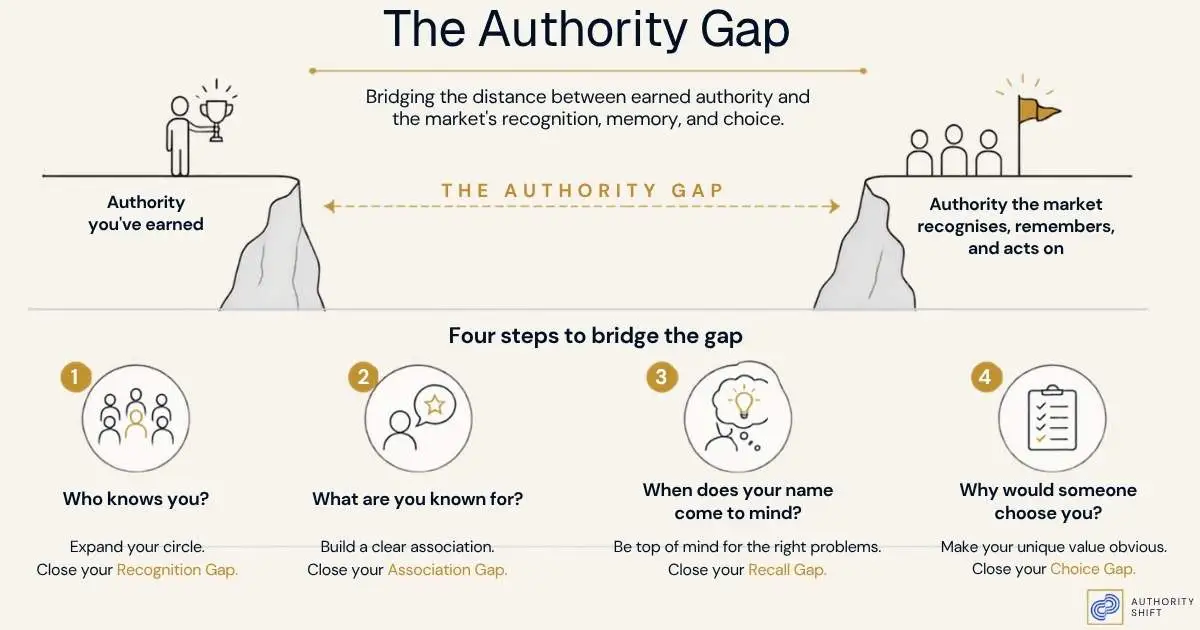
The Authority Gap is the distance between the authority you have earned and the authority the market recognizes, remembers, and acts on. It can appear as a gap in recognition, association, recall, or choice.
When I began writing on LinkedIn in January 2022, I thought visibility was the main problem. If more of the right people saw my work, surely more opportunities would follow.
Writing every day for more than 650 days taught me a great deal about visibility. Working with leaders on books, LinkedIn, websites, career transitions, and solo businesses taught me something more important.
Many of those leaders were already deeply trusted by people who knew their work. Clients respected them. Colleagues knew how good they were. Yet outside that circle, the market often had only a faint idea of what made them valuable.
That was when I began to see that "I need more visibility" is often too broad a diagnosis.
Sometimes, more visibility simply helps the wrong story travel further.
Your Authority Spine points one way. Does the market point there too?
Before diagnosing your Authority Gap, it helps to know what you want to be known for. I call that your Authority Spine: the one sentence that captures whom you want to help, the result you help create, and why the right people should think of you first.
Think of it as your intended direction.
Now comes the more revealing question: is that the story the market is actually carrying about you?
If you do not yet have your Authority Spine, join the Authority Shift Letter. You will receive the guided process shortly after subscribing.
Once you know your intended direction, four questions can show where the distance begins.
1. Who knows you?
Start with the people who already know your work: clients, former colleagues, industry peers, readers, and people who have heard you speak.
Inside that circle, your authority may be strong because people have seen you think, decide, solve, and deliver. They already have evidence. You do not need another polished headline to persuade them.
Now look just beyond that circle.
How many of the people you would like to work with next know you exist?
That is your Recognition Gap.
The goal is not to become famous. It is to become known by more of the right people.
2. What are you known for?
Imagine asking ten people who know you well:
"What do you think I am the go-to person for?"
Would their answers point in roughly the same direction?
One person may describe your old corporate role. Another may talk about your leadership skills. Someone else may remember a book you wrote. A former client may understand a much deeper capability that hardly anyone else sees.
All those versions may be true. The problem appears when the market cannot connect your name with the work you most want to be known for.
That is your Association Gap.
Your Authority Spine captures the association you want to build. This question reveals whether that association already exists in other people's minds.
3. When does your name come to mind?
This is where authority becomes commercially interesting.
Imagine someone says, "We need a person who can help us with _________."
Does your name appear?
You can be admired by hundreds of people and still be forgotten at the exact moment a client, speaking opportunity, board role, podcast invitation, or introduction appears.
That is your Recall Gap.
Psychologists Amos Tversky and Daniel Kahneman used the term availability heuristic to describe how the ease with which something comes to mind can affect judgment. Their research was not about professional authority, but the connection raises an important question: how readily does your name come to mind when someone encounters the problem you solve?1
This was an aha for me:
Authority is not only about what people think when they see your name. It is also about whether your name appears when they see the problem.
You do not merely want people to recognize your name. You want the right problem to bring your name to mind.
4. Why would someone choose you?
Now assume your name makes the shortlist.
Why you?
What does someone expect to receive from your experience, judgment, point of view, or approach that makes you especially right for this situation?
This is not about claiming that nobody else can do what you do. The person making the decision is usually choosing between several credible experts. They need enough clarity to understand why you belong near the top of that particular list.
If people know you, understand your work, and remember you at the right moment, yet struggle to explain why they should choose you, you have a Choice Gap.
Good experts meet other good experts here all the time.
Where is your Authority Gap?
Place your Authority Spine beside these four questions:
- Who knows me?
- What do they know me for?
- When does my name come to mind?
- Why would they choose me?
Notice where your answer becomes vague.
You may discover that you do not need a larger audience right now. You need a stronger association between your name and one important problem.
You may find that people understand your expertise but do not remember you when the decision happens.
Or the people closest to your work may already tell exactly the story you want the wider market to hear. In that case, your next task is helping that story travel.
That is why I prefer diagnosing the gap before prescribing the solution.
Otherwise, we risk solving every authority problem with "post more."
The internet already has plenty of posts.
Try this with one person
Think of one former client, colleague, business partner, or person who has recommended you before. Choose someone who has seen enough of your work to have formed a real opinion.
Call them and ask:
"If someone asked you what I am the go-to person for, what would you say?"
Do not guide them. Let the answer come from them.
Their first response gives you a glimpse of the association your name already carries in someone else's mind.
Now compare it with your Authority Spine.
If the two are close, your Authority Brand may already be traveling in the direction you want. If they are far apart, you may have found your first Authority Gap.
If the answer surprises you, join the Authority Shift Letter and reply to the welcome note with what they said. I would enjoy helping you spot what the distance between the two stories may be revealing.
About the Authority Gap
The Authority Gap is a practitioner concept developed by Shiv Shenoy through his work with leaders, authors, senior professionals, and independent experts.
It describes the distance between earned expertise and market recognition across four areas:
- Recognition: Do the right people know you?
- Association: Do they know what you are the go-to person for?
- Recall: Does your name come to mind when the relevant problem appears?
- Choice: Do they understand why they should choose you?
This is a working model within the wider Authority Shift body of work on how expertise becomes recognized, remembered, and selected.
Reference
- Tversky, A., and Kahneman, D. "Availability: A Heuristic for Judging Frequency and Probability." Cognitive Psychology, 1973.
Shiv Shenoy
Author & founder of Authority Shift