How to Fix What People Know You For
Close the Association Gap without losing the trust you've already earned.
"Wait, you do all of that?"
I was explaining my work to one of my early book-coaching clients.
"I thought you only helped people write books."
Fair enough. That was the work she knew.
"I still do," I said. "But now we start with what someone wants to be known for. Then we work out what will help them get there. Their LinkedIn, book, website, newsletter, articles, and maybe even their offer."
"Oh. I didn't know that."
She had worked with me. Yet I still had to explain what she could hire me for today.
How many other people still knew only the book part? And what work would they send my way?
My work had grown. Her picture of it hadn't.
People can know you well and still know only a part of your work.
Your work grew. Did your reputation?
In my work on Authority Branding, I call this the Association Gap.
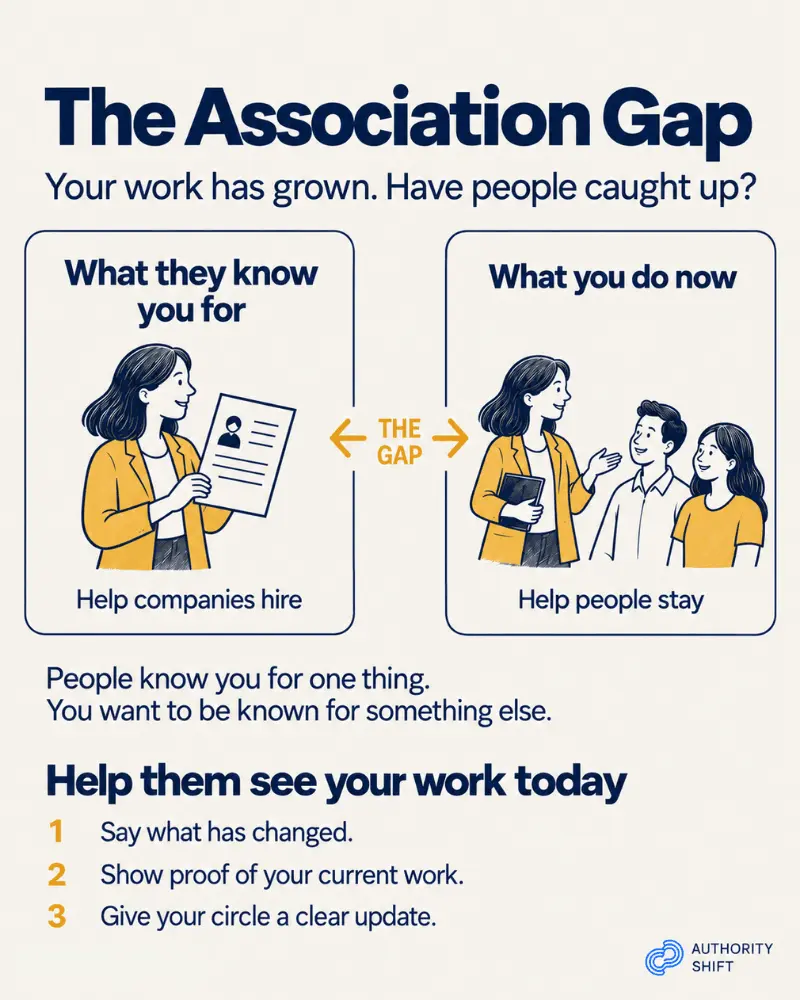
An Association Gap happens when people know you for one thing, but you want to be known for something else.
It can happen when your work grows wider, as mine has. It can also follow a change in direction.
Imagine a consultant who spent years running hiring projects. Companies paid her to find and place people.
Now she helps companies keep their best people. She studies why staff leave and helps leaders change the work, management, or career paths behind those exits. That means she now offers a much bigger value to her clients.
But a past client still recommends her for filling vacancies.
Another hiring project arrives. It pays well. She takes it. The client then recommends her for more hiring work.
Her reputation is doing its job. It keeps building demand for the work people already know, and not the work she wants.
Why the old label keeps getting stronger
People describe the work they've seen. A past client may know one service. A former colleague may know one role.
Neither has followed every change since then.
Meanwhile, the expert may keep giving them reasons to hold the old view. A LinkedIn headline names the earlier role. Reviews praise the original service. Recent posts still draw on the same projects.
Even someone looking them up online today can leave with an old picture.
And each new project in the old area adds another result, review, and referral.
Old work creates fresh proof of an old label.
Over time, that work can fill the calendar. The newer work gets less time and produces less visible proof.
Changing this takes a clear choice about what to bring forward.
How to make your current work clear
Start with the help you want to give more of.
Our consultant could say: "I help companies understand why good people leave and fix the causes."
Now look at the places where people learn about her work.
Does her website offer that help? Does her LinkedIn profile explain that? Does her first case study show her solving that problem?
If the website headline talks about keeping staff but the service page only offers recruitment, a buyer still has to guess what they can hire her for.
Your words, proof, and offer need to support the same direction. That is a practical part of professional positioning.
You can keep several services. Make their place clear. In my case, authority branding explains the wider purpose. A book is just one way we can support it, to gain instant credibility and trust.
How to use your past without getting stuck there
Our consultant's hiring experience still matters.
She may have seen the same roles become vacant again and again. That experience could help her ask better questions about why people leave.
Then she needs proof from the newer work: a real problem she studied, what she found, what she advised, and what followed. With permission, that example can become a case study. A client's account of the work can support it.
Choose proof based on what it helps someone understand about your current work. Your biggest past result may point toward a service you want to do less of.
Bring forward the example that supports the next conversation you want. Your Proof Bank is a useful place to start. Your past can support your career repositioning.
Can people change their view?
Yes. In experiments, Thomas Mann and Melissa Ferguson found that first impressions could change when new facts changed how people understood someone's earlier actions.1
My takeaway for your work: explain how your past experience helps you solve the problem you focus on today.
Our consultant can explain how years of hiring helped her spot why people leave. Then she can share a real example of helping a company keep its staff. That gives people a clear link between the work they know and the help she offers now.
Give people an update they can pass on
Your past clients and colleagues may be ready to help. They may simply need new words.
Start with what they know. Explain what has changed. Add a real example where possible.
Our consultant could say: "You know my recruitment work. Today, I also help companies understand why people leave and make changes that help them stay."
For me, the update begins with the book work a client already knows, then explains how it fits within the wider authority branding service.
Keep supporting that update through fresh examples. One conversation helps one person. Your profile, articles, and case studies can help the next person understand without needing the same explanation.
Start with people in your Decision Network who already know your work and make introductions.
Fix one mismatch this week
Follow the path someone would take before referring you.
- Read your LinkedIn headline and About section.
- Look at the first proof they see in the Featured section.
- Check the service you invite them to buy.
Fix the first place that points them toward the wrong work. Then update someone who has referred you before.
Watch what changes. Do their introductions use the newer description? Do inquiries begin with the problem you now want to solve? Those are useful signs of progress.
My former client knew the work we'd done together. Our conversation gave her a fuller picture.
Who in your circle might need that same update?
Cheers,
Shiv
P.S. If you're serious about building your authority brand over the next six months, let's talk. We can look at the work you want more of, the proof you've built, and how to help people see your value and bring you the specific opportunities you seek.
References
- Mann, T. C., & Ferguson, M. J. (2015). Can we undo our first impressions? The role of reinterpretation in reversing implicit evaluations. Journal of Personality and Social Psychology, 108(6), 823–849.
About the Association Gap
The Association Gap is a practitioner concept developed by Shiv Shenoy, founder of Authority Shift, to describe the difference between what people know an expert for and the work that expert wants to be known for.
It sits within the broader Authority Gap. This article focuses on outdated or incomplete views of someone's work.
The concept draws on Shiv's work on his own business and with experts across industries globally. The research cited provides related context, rather than scientific validation of the approach.
Shiv Shenoy
Author & founder of Authority Shift