When Your Past Starts Choosing Your Future
Your experience should give you proof for the future, not lock you into the past.
You can spend 20 years becoming the obvious choice for work you no longer want.
A senior executive starts thinking about consulting, but recruiters keep calling with bigger operating roles. A CFO wants board work, but people still introduce her as "the finance person." A technology leader wants to advise CEOs on business change, but most of the evidence around him still points to systems and delivery.
Their track record is not failing them.
It is working exactly as expected. Years of projects, titles, referrals, and conversations have taught other people what to associate with them.
So when they want something different, the market keeps sending them more of the past.
Note — By the end of this article, you'll have a simple way to decide what from your past should come with you, what can stay behind, and how to use your experience as proof for the direction you want next.
What is career repositioning?
Career repositioning means changing what people associate you with while using the right parts of your past experience to make your new direction believable.
The work you want has changed
You can change your plans faster than other people can change their picture of you.
That gap matters more as your career gets longer. The more success you have in one area, the more evidence there is connecting your name to that kind of work.
This is why career repositioning can feel strange for experienced people. You are not starting without credibility. You may have too much credibility pointing in the old direction.
Throwing it all away makes no sense either. Much of what makes you ready for the next chapter came from those same years.
So the useful question is:
Which parts of my past deserve a place in my future?
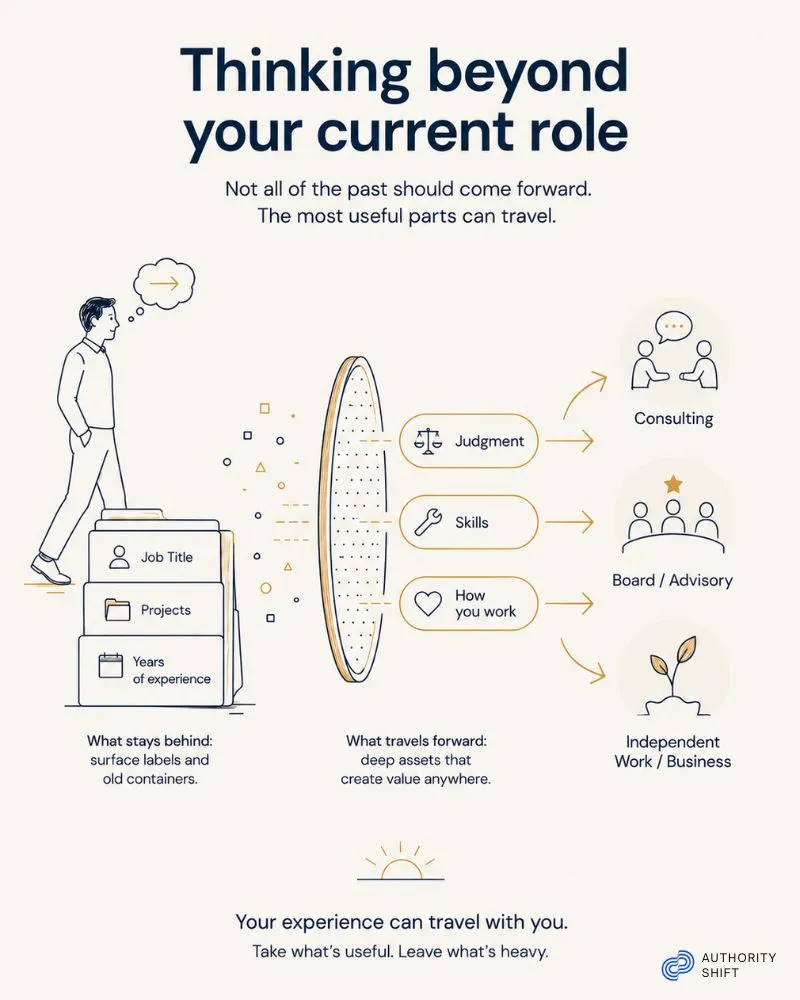
Keep the experience, not the old label
A job title tells us where the experience came from. It does not tell us everything the experience built.
Take someone who spent 15 years leading technology programs. The label may be "technology program leader." But those years may also have taught her how large companies make decisions, how to get several teams moving together, how to spot risk early, and what to do when nobody wants to own a difficult call.
Those abilities can travel.
I saw this in my own career.
I moved from project management coaching into authority branding. It was a real pivot. The subjects were different, and I did not simply rename the old business.
But I brought parts of the old work with me.
Project management taught me how to break a large piece of work into smaller parts, sequence it, manage dependencies, and keep work moving. Product development taught me to build, test, learn, and improve.
I use those same ways of thinking today when I help create books, LinkedIn presence, newsletters, websites, and other parts of an authority brand.
The old field changed.
The useful thinking came with me.
Make the new direction believable
Finding transferable skills is useful, but people still need a reason to believe you can succeed in the new direction.
This is where your past becomes proof.
If your proof is scattered across years of work, collect the proof you have already earned and give each piece a job before deciding which ones belong in your new positioning.
Suppose a senior finance leader wants board roles. Repeating "20 years in finance" will keep strengthening the finance label.
Instead, she can look inside those 20 years.
- Where did she make calls involving risk?
- When did she work on an acquisition?
- Where did she influence capital decisions, governance, or a difficult trade-off that affected the whole company?
Those experiences help someone see why she can contribute in a boardroom.
Nothing about her history has changed.
She has changed what that history is being asked to prove.
The same logic works for a bigger career transition. If you move from employment into consulting, future clients do not need every detail of your career. They need the parts that show you understand the problems you now want to solve.
Your past should help make the new direction easier to believe.
If you are considering a change
You do not need to change direction just because you have had a long career. If you enjoy the work your reputation brings you, keep building on it.
But you may be thinking about consulting, advisory work, board roles, starting a business, or simply doing different work with more control over your time and the problems you take on.
If so, take five experiences from your past and ask three questions.
- What did I do? Describe the work plainly.
- What does it prove? Look for the ability, judgment, experience, or trust underneath the old role.
- What could it support next? Ask which future role, client, project, or business becomes easier to believe because of that evidence.
Some experiences have done their job and can stay in the past.
Others may become more useful once you stop describing them through the old label.
A difficult project may prove judgment. A client crisis may prove that you can handle pressure. Years spent inside one function may have taught you something that future clients outside that function badly need.
This is why a long career does not have to narrow your choices.
It can give you more of them.
Your experience should give you proof for the future, not lock you into the past.
If you are considering a change in direction, the next useful question is not simply what you want to do.
It is what you want people to choose you for next, and which parts of your existing experience make that choice easier to believe.
Cheers,
Shiv
Want help deciding what you should become known for next?
If the work you want next is different from what people associate you with today, I can help you work through the shift.
Tell me what you want to become known for, what you have already built, and where the old association seems to be holding you back.
Shiv Shenoy
Author & founder of Authority Shift