Build Your Proof Bank
Find the proof you already earned, know what it proves, and use it when it matters.
A good opportunity can make even an experienced person forget half a career.
A client asks for a proposal. A senior role opens. Someone wants to introduce you to a buyer. A conference asks for your speaker bio. You have years of work behind you, yet one question suddenly feels harder than it should:
What should I show them?
Your biggest project? The best-known client? A senior title? An award from five years ago?
The problem is usually not a lack of proof. It is that your proof is spread across years of work, old emails, project files, LinkedIn, client feedback, and your own memory.
Note — By the end of this article, you'll have a simple way to find that proof, organize it, and put it to work. I've also created a Proof Bank spreadsheet you can download and start using today.
What is a Proof Bank?
A Proof Bank is a simple record of the proof you have earned, what it shows, who needs it, and how you can put it to work.
Start with the question they still have
Before you collect your proof, it helps to know what you are looking for.
Say a company is considering someone to lead a large change program. Their real question could be: "Should we trust this person with something this big?"
Now look for what could make them hesitate. They may like the person's ideas and know they have experience, but still wonder: "Have they handled this level of scale before?"
That tells us what they need to believe. They need confidence that this person has handled complex work across many teams and markets.
Now a program across 6 countries becomes strong proof.
The six-country project matters because it answers the question still sitting in the buyer's mind.
A simple way to think about it is: understand what they are deciding, find what could make them hesitate, work out what they need to believe, and then choose the proof that supports it.
Your best proof is the proof that answers the biggest doubt.
Now find the proof you already earned
Here is the encouraging part: you may already have far more proof than you use.
Do not open a blank page and ask, "What proof do I have?" Your brain can choose that exact moment to forget your entire career.
Give it places to look.
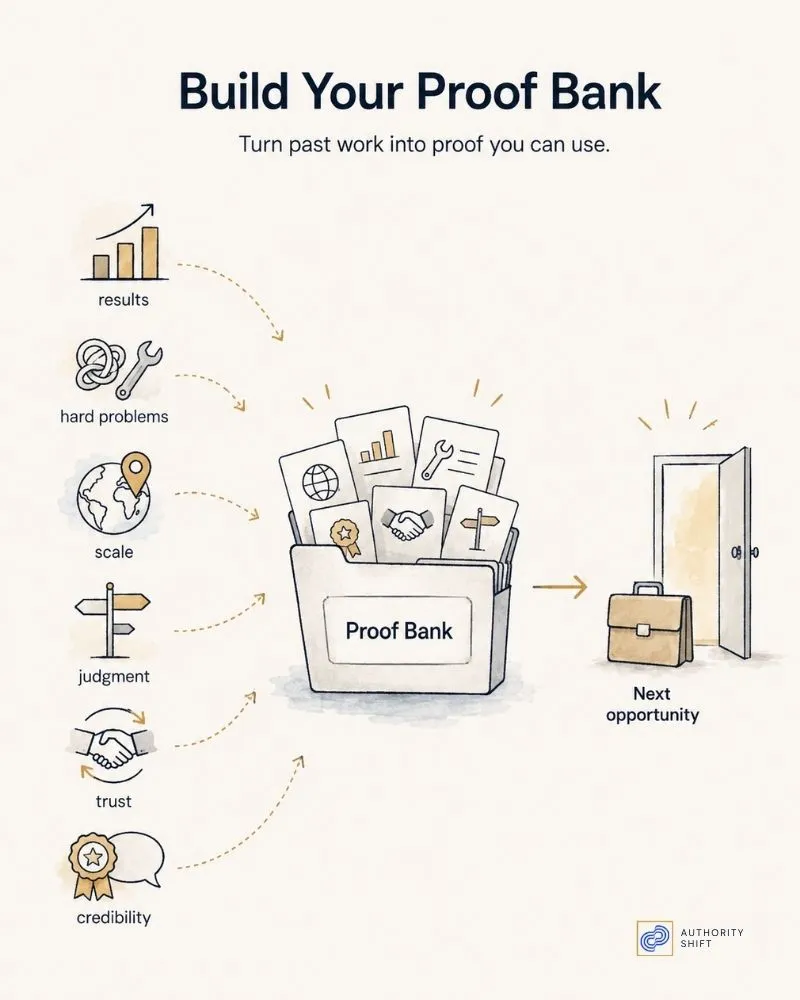
- Start with results. What got better because of your work? Think about revenue, cost, time, speed, quality, growth, a target reached, or a problem reduced.
- Then look at hard problems. What was stuck, failing, risky, or difficult before you got involved?
- Next, look at scale. Think about teams, budgets, markets, locations, systems, projects, or senior stakeholders.
- Then look for judgment. When did you spot a risk early, change direction, say no, or make a hard call that later mattered?
- Look for trust too. Did a client renew? Did someone refer you? Did a customer come back? Did a leader give you more responsibility?
- Finally, gather credibility that already sits around your work: testimonials, recommendations, awards, books, patents, major roles, media mentions, qualifications, and speaking invitations.
You are not trying to make yourself sound more impressive.
You are collecting evidence of work you already did.
Give every piece of proof a job
Finding the proof is only half the work. You also need to know what it shows.
Take this line:
"Led change programs across 6 countries."
It is a useful fact, but the reader still has to work out why it matters.
Now compare it with:
"Leading change programs across 6 countries taught me how quickly a good plan can fail when local teams are brought in too late."
The experience is the same. The second version tells us far more. We see what the person did and what the work taught them.
That is a simple way to demonstrate expertise without having to announce that you are an expert.
The proof does the work.
This is why a useful Proof Bank needs more than a list of achievements. For each item, capture what happened, what it shows, what question it can answer, who would care, how you could say it simply, where you could use it, and where the evidence lives.
One old win can work many times
This is what makes the idea useful for building professional credibility.
A project could strengthen a proposal today. A lesson from that project could become a LinkedIn post next week. The same experience could support your website, a sales call, a speaker bio, an interview, or a case study later.
You do not need to start proving yourself from zero each time a new opportunity appears.
The proof you already earned can start doing double duty: validating your past and helping create your next opportunity.
You already did the hard part. You earned the result, the experience, and the trust.
Now make sure that work does not disappear into your past.
Start with ten
Do not try to map your whole career this weekend. Start with ten pieces of proof.
Use the six areas above to find them. Add each one to your Proof Bank. Then pick one opportunity you want next and ask what the other person is deciding, what could make them hesitate, and what they need to believe.
Then look through your Proof Bank.
You may discover that the evidence you need is already there.
If you want to build authority in your field, this is a good place to start. You do not always need another achievement. You may need to get more value from the ones you have already earned.
I've created a ready-to-use spreadsheet with the Proof Bank and an Opportunity Match sheet to help you choose the right proof for a real opportunity.
Download the Proof Bank template.
And if you build your first ten, I'd love to hear what surprised you. Tell me what you found.
See you next Saturday,
Shiv
Want help building your authority?
If you want to become better known and sought after for your expertise over the next six months, tell me what you want to become known for and where you feel stuck.
Shiv Shenoy
Author & founder of Authority Shift