You Do Not Need a Bigger Audience
Map the people behind your next opportunity.
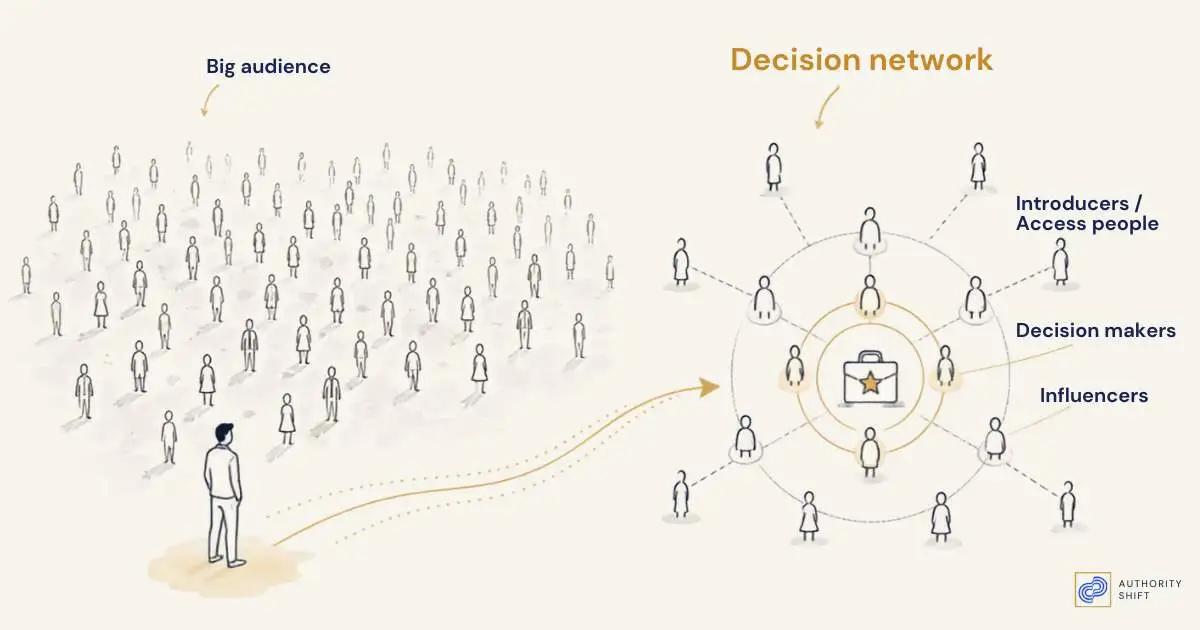
Your Decision Network is the small group of people who can create an opportunity, shape the decision around it, or help your name reach the people who can say yes.
There is usually a point when an experienced professional decides they need more visibility.
Perhaps the next clients are not coming from the old network. Perhaps they want to speak on better stages, join a board, move into a different kind of role, or become known beyond the people who already trust them.
The natural answer is to reach more people. Grow the audience. Get more followers. Become more visible.
But take one opportunity you would genuinely like in the next 12 months and look at it closely. The number of people who can help it happen is often surprisingly small.
That changes the problem.
Start with one opportunity
Do not begin with your whole career, business, or market. Pick one opportunity you would be pleased to receive in the next 12 months.
It could be a certain kind of consulting project, two respected speaking invitations, a board role, a senior position, a book deal, or a partnership. Make it specific enough that you can picture the email, phone call, or introduction that would tell you it had happened.
"Become more visible" is too wide.
"Speak at two major industry conferences next year" gives us something we can work with.
Now we can work backwards.
Who sits around that opportunity?
Take a blank page and ask three questions:
- Who can say yes?
- Who do they listen to?
- Who can put my name in front of them?
For a keynote, the person who can say yes may be an event director or conference organizer. But that person may ask previous speakers, sponsors, industry leaders, or an events agency for recommendations. Somewhere else in that network may be a former client or respected peer who already knows your work.
For a consulting project, the decision maker may be a CEO or business leader. Around them may be investors, advisers, members of the leadership team, or peers they call when a difficult problem appears. Some of those people may already be much closer to you than the buyer is.
This is your Decision Network taking shape.
You do not need every name immediately. Start with the roles, then add real people where you can.
Why the people around the decision matter
Opportunities rarely move through perfectly straight lines.
A useful piece of research has been sitting underneath this idea for more than 50 years. In his landmark 1973 paper, sociologist Mark Granovetter showed why people outside our closest circles can matter so much: weaker connections often act as bridges between groups, carrying information and opportunities into places our close network does not reach.1
That does not mean every acquaintance is strategically important, or that strong relationships matter less. It means the path to an opportunity can run through people who sit between networks.
The person who hires you matters. So can the person they call before deciding whom to hire. And the person who knows both of you may matter more than either of you realizes.
This is why professional authority cannot be judged only by the size of the audience around you. The position of the right people inside that audience matters too.
What happens when your name comes up?
Finding the right audience is only half the work.
Imagine someone in your Decision Network is asked for a recommendation and your name comes to mind. What happens next?
"I know her" is useful. But it leaves a lot of work for the other person.
"She is excellent at helping leadership teams communicate during major change" gives the recommendation somewhere to go.
People rarely carry our full career story into a room. They recall a much smaller version: a name, a problem, a strength, perhaps one piece of proof.
This is where your Authority Spine becomes useful. It gives you a clear answer to what you want to be known for, whom you help, and the value people should associate with your name. You would have built yours from the very first email I sent when you signed up to my newsletter.
Now look at the important people on your map and ask:
What would they need to know about me before they could confidently bring my name into the conversation?
Perhaps they need to understand the work you do now. Some of them may still associate you with something you stopped doing five years ago. Some of them may trust you deeply but could not explain, in one sentence, why someone else should call you.
That is valuable information.
It may also reveal an Authority Gap: distance between the authority you have already earned and the authority the wider market can recognize, remember, and act on.
Follow their attention
Only now does the question of visibility become useful.
Where do these people already pay attention?
Perhaps it is LinkedIn. It may also be a small industry event, a professional group, a newsletter, a podcast, a trade publication, or simply a few people whose judgment they respect.
You do not need to appear everywhere. You need enough of the right people to meet your thinking often enough to understand what you are good at and remember you when the relevant need appears.
That changes the role of writing, speaking, books, podcasts, events, and introductions. They stop being separate visibility activities. They become ways for your thinking to reach people who sit closer to the opportunities you want.
Reach tells you how far your work traveled. Your Decision Network tells you whether it traveled towards something you want.
Make one 90-day decision
You should now have four things in front of you:
- One opportunity
- The people around it
- What they need to know about you
- The places where their attention already goes
Do not turn this into a 47-tab personal-brand spreadsheet. The point is clarity.
Finish one sentence:
For the next 90 days, I want to become easier to notice by ______, in ______, for ______.
A consultant might write:
For the next 90 days, I want to become easier to notice by CEOs and the advisers they trust, in the places where they already discuss growth problems, for my work on turning complex strategy into action.
Someone seeking speaking work will have a different sentence. So will an executive preparing for the next role.
The value is that we now know what visibility is supposed to do.
The useful audience may be smaller than you think
A bigger audience can create more possibilities. There is nothing wrong with that.
But when you know the kind of opportunity you want next, a better question to ask would be:
Do the people around that opportunity know why my name should belong in the conversation?
Take one opportunity and map the people around it. Then look at where you are currently spending your time and attention.
You may discover that the next step is much smaller than "grow my audience."
And much more useful.
Cheers!
Shiv
About the Decision Network
The Decision Network is an Authority concept developed by Shiv Shenoy. It describes the small group of people who can create an opportunity, shape the decision around it, or help a professional's name reach the people who can say yes.
The idea shifts attention from audience size alone to the people, relationships, associations, and paths through which professional opportunities actually move.
Reference
- Mark S. Granovetter, "The Strength of Weak Ties," American Journal of Sociology, Vol. 78, No. 6, 1973, pp. 1360–1380. DOI: 10.1086/225469.
Shiv Shenoy
Author & founder of Authority Shift