Your LinkedIn Profile Should Help People Choose You
Four ways to help potential clients understand your value and reach out, even while you're away.
When my mother passed away, I stepped away from LinkedIn for about three and a half weeks.
I needed that time with my family.
During my absence, inquiries still came through LinkedIn. A couple later became signed contracts.
I didn't have a website, articles, or a newsletter supporting that work then. I had my LinkedIn presence.
I don't know exactly what brought each person to me. Some may have read earlier posts. Others may have heard my name from someone.
But they could visit my profile and contact me while I wasn't posting.
If you're taking a break from LinkedIn, that matters. You may have no time to write, yet someone could be deciding whether to speak with you.
Today, we'll use four questions to improve your LinkedIn profile so potential clients can understand your value and reach out.
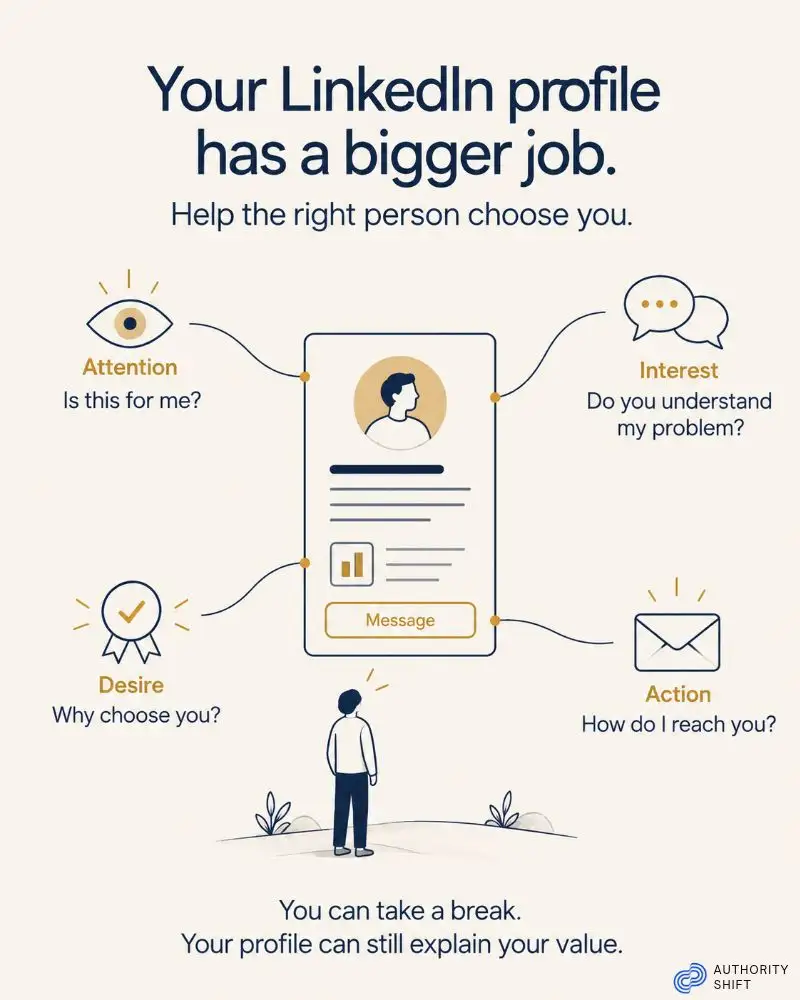
Give your profile a bigger job
Your profile explains your positioning: what you do and who you help.
An interested visitor needs more. They want to know whether you understand their problem, why they should trust you, and what working with you involves.
A LinkedIn profile for consultants and other experts should help people make those decisions.
AIDA gives us a way to plan this.
What is AIDA?
AIDA is a marketing model with four parts: Attention, Interest, Desire, and Action. It helps you plan how to move someone from noticing your work to taking a next step.1
For your profile, each part has a job:
- Attention: Help someone recognize the fit.
- Interest: Show you understand their problem.
- Desire: Give them reasons to choose you.
- Action: Make it easy to contact you.
I didn't deliberately follow this model before my break. I'm using it here to explain how a profile can help someone decide.
Let's imagine you're a consultant helping founders build teams that make decisions without asking them about everything.
1. Attention: "Is this for me?"
A founder opens your profile after spending the morning approving routine decisions.
Your headline says:
"Leadership consultant and executive coach."
That names your field. The founder still has to work out whether you address their problem.
Consider:
"I help founders build teams that make decisions without waiting for them."
Now they can recognize something they want.
You can still include your role. Give the right visitor a clear reason to read further.
If your headline still describes work you've moved beyond, start by closing that Association Gap.
Does your headline tell them your role, or help them see why they might need you?
2. Interest: "Do you understand my problem?"
Use the opening of your About section to describe a situation your potential client knows:
"You've hired capable people. Yet decisions still come back to you. You delegate the task, but the questions keep coming."
Then explain your help:
"I help you agree on which decisions your team can make, where they need limits, and when they should involve you."
The founder can picture the work.
Compare that with "I help leaders unlock their potential." What would they expect you to do?
Specific words make it easier to judge whether a conversation would be useful.
3. Desire: "Why would I choose you?"
Choose a relevant example for your Featured section or experience details. Explain the problem, your decisions, and what changed.
For this service, you could share a real case where you helped a team handle routine purchases within agreed spending limits.
Why those limits? What still needed the founder's approval? What improved?
Use results you can support and details you have permission to share. Explain why you chose that approach. Those decisions show how you think, so potential clients can understand what you bring beyond the result.
Then explain how someone can work with you. Is it an assessment, a workshop, or ongoing support?
Help them picture both the result they want and the help they would receive.
An impressive career history alone may leave those questions unanswered.
4. Action: "How do I begin?"
Someone may want your help and still hesitate.
What should they write? Is their problem suitable? Will a message commit them to a sales call?
Give them an easy opening:
"Message me with one decision your team keeps bringing back to you. I'll ask a few questions to see whether I can help."
Choose one main contact route. Offer a business email as an alternative. Include a phone number if you welcome calls.
Make those details easy to find. Ask someone outside your connections to check what they can access.
Keep this invitation in place all the time. You shouldn't need a profile rewrite whenever life gets busy.
For planned time away, an email auto-reply can explain when you'll respond. If the break is sudden, reply when you're able.
Make it work for someone who skims
Research by Nielsen Norman Group found that people often scan web pages rather than read every word. Concise text and layouts that were easy to scan improved usability in its tests.2
My takeaway for your profile: don't bury the reason to hire you inside a long career story.
Use short paragraphs. Label client examples clearly. Keep contact details easy to find. Someone who skips a section should still understand your help.
Test your profile before your next break
Ask someone to read your profile with a specific client problem in mind.
Can they tell you:
- Who your help is for?
- What you would help them change?
- Why they should consider you?
- How to start a conversation?
Fix the least clear answer first.
This won't create visits by itself. Earlier posts and people in your Decision Network may bring visitors. Your profile helps them decide what to do once they arrive.
You can take a break. Your profile can still explain your value.
Want more practical ways to turn your experience into opportunities? Subscribe to Authority Shift Letter. It's free, every Saturday.
If you want help connecting your positioning, proof, and LinkedIn presence around the work you want more of, let's talk.
References
- Adobe. Learn about the sales funnel and how to optimise it for the best results. Read the source.
- Nielsen, J. (1997, September 30). How Users Read on the Web. Nielsen Norman Group. Read the research.
About Shiv Shenoy
Shiv Shenoy is the founder of Authority Shift. He helps founders, CXOs, consultants, and other experts become known beyond their own circle and attract better opportunities.
His work connects positioning and proof with LinkedIn presence, books, newsletters, articles, and websites. This article applies the established AIDA model to LinkedIn profiles; it does not introduce a new model.
Shiv Shenoy
Author & founder of Authority Shift