Why Useful Content Is Not Enough
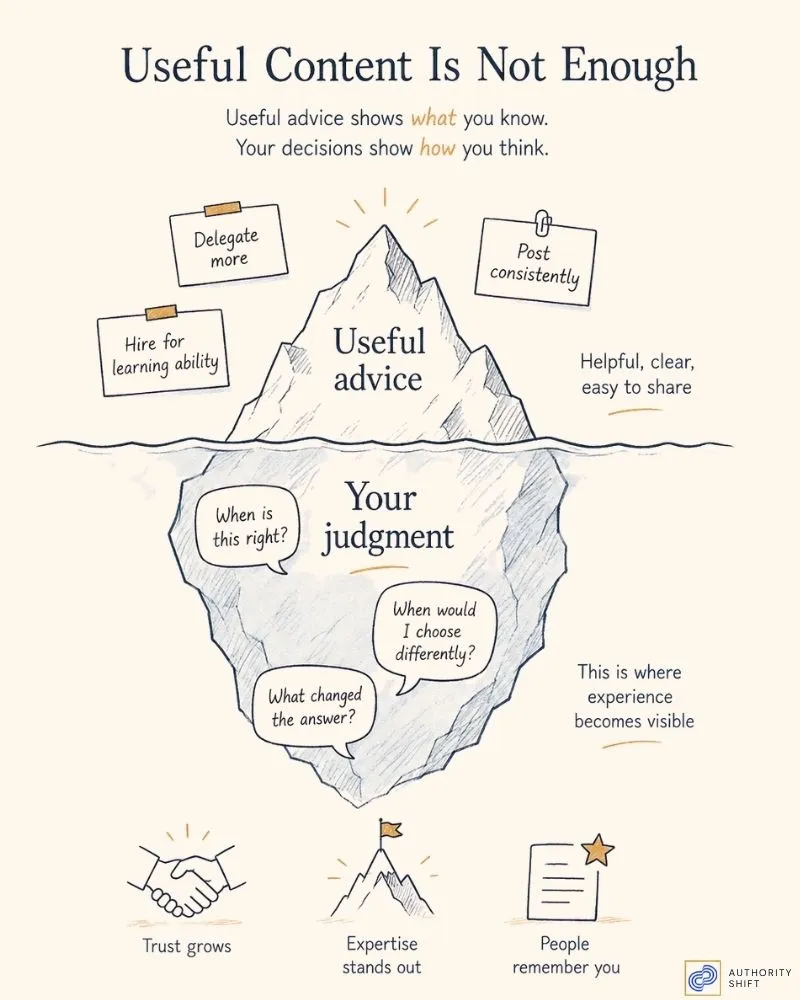
The advice shows what you know. The decision behind it shows how you think.
What makes thought leadership content valuable?
Strong thought leadership content does more than share useful advice. It makes expert judgment visible by showing the conditions, trade-offs, and decisions behind the recommendation.
Over time, I started noticing something uncomfortable about my own content.
Some of my posts were clearly useful. People could learn from them, save them, apply them — some of them even wrote back. But a few of those posts revealed very little about how I actually think when I make a decision.
That created a problem I did not immediately recognize. Someone could agree with my advice without learning much about the experience behind it. And if they cannot see how you think, they also cannot reliably judge when to trust you beyond the obvious cases.
So I started asking myself a question before publishing:
Am I only telling people what I know, or am I also showing them how I arrived at it?
For experienced professionals, that difference matters. People are not only deciding whether your advice is useful. They are also collecting signals about whether they would trust your judgment when the answer is less obvious.
And that is the real test of expertise.
Good advice can hide the expert
Good advice hides expertise when it is stripped of context.
Imagine three experienced consultants writing about delegation.
One tells leaders to set clear outcomes, give people ownership, and avoid micromanaging. It is good advice. The other two could quite reasonably recommend something similar.
All three consultants may be excellent at what they do. Yet if you faced a difficult delegation problem tomorrow, their content has given you very little reason to choose one over the others.
Their expertise is real. It is simply not visible in the advice itself.
This happens with a lot of thought leadership content. We try so hard to make an idea useful that we strip away the very thing that came from years of doing the work: the conditions, trade-offs, exceptions, and decisions behind the advice.
The more useful question is not only, "What do you recommend?"
It is: "What makes you recommend it?"
Experience changes the answer
Early in our careers, we learn rules. Experience gradually adds conditions to those rules.
"Delegate more" becomes: delegate when the person can safely learn from the result. Stay closer when the decision is difficult to reverse.
"Hire for learning ability" becomes: prioritize learning speed when the work changes quickly. Give proven experience more weight when one mistake can create serious risk.
The original advice did not become wrong. The situation changed.
And that is one of the things experience gives you: the ability to notice which detail matters enough to change your answer.
That is where expert judgment becomes visible.
Knowledge can tell someone what is possible. Judgment tells them what you would choose, given this situation, these risks, and these trade-offs.
What research on expertise adds
Research on real-world expert decision-making gives us an interesting connection here. Gary Klein's Recognition-Primed Decision model grew from studying experienced professionals making decisions in demanding situations. His work describes how experience helps people recognize meaningful patterns in a situation and identify a plausible course of action.1
Daniel Kahneman and Gary Klein later made an important qualification: experience does not automatically produce reliable judgment. Strong intuitive expertise is more likely when the environment contains patterns that can actually be learned and the person has had enough opportunity to learn them.2
That distinction matters here.
Years of experience alone are not the point. What one learns to notice because of those years is.
An opinion is different
There is another distinction worth making because thought leadership is frequently confused with having strong opinions.
"I hate meetings" is an opinion.
Now compare that with: "When several teams need to make trade-offs together, I would put them in a meeting. If everyone simply needs the latest status, I would not."
The second statement tells you much more. You can see the condition, the choice, and the reasoning behind it.
You may even disagree with the answer. That is fine.
Building professional authority does not require everyone to agree with you. It requires people to understand enough of your thinking to decide whether they respect and trust it.
Here is one from my own work
Take a common piece of advice in my field:
"Post consistently on LinkedIn."
There is nothing wrong with it. But I would not give that advice to every experienced professional in the same way.
If people still cannot clearly explain what you should be known for, publishing more would not be the first problem I would solve. More content could simply spread an unclear message further.
I would first get clearer about the association we want your name to create.
For someone else, that association may already be clear. Their problem may simply be that too few relevant people are seeing their thinking. In that case, publishing more consistently could make perfect sense.
Same platform. Same broad advice. Different decisions.
And that tells you far more about how I work than "post consistently" ever could.
That is what strong thought leadership content can do. It gives people access to some of the thinking beneath your recommendation.
Find the decision inside your advice
Let's find one from your own work.
Choose one piece of advice you give regularly. It could be something you tell clients, colleagues, your team, or people who follow your work.
Keep it simple. For example:
Senior leaders should delegate more.
Now work through four questions:
- When is this advice right? What needs to be true for you to recommend it?
- When would you advise differently? Find the exception. There is usually at least one.
- What changes your answer? Look for the deciding factor: risk, timing, cost, experience, reversibility, or something else.
- Why does that factor matter? This is where years of experience begin to show.
Now turn what you found into four sentences:
A common answer is ______.
I would choose ______ when ______.
I would choose ______ instead when ______.
The deciding factor is ______.
Let's use our delegation example.
A common answer is to delegate more. I would delegate when the person can safely learn from the result. I would stay closer when the decision is hard to reverse and the person has never handled it before. The deciding factor is the cost of getting the decision wrong.
Notice what happened.
We did not invent a new idea. We did not add another tip. We simply made the thinking behind familiar advice visible.
Your best content may already exist
General advice is relatively easy to repeat. Your judgment is much harder to copy.
It comes from the situations you have handled, the mistakes you have watched unfold, the trade-offs you have made, and the patterns you have learned to notice. Those are the parts of your experience another person cannot recreate by reading the same books or asking an AI tool for ten tips.
So you may not need another topic for your next article, newsletter, video, or post. You may already have one hiding inside advice you have repeated for years.
Take that advice and ask two questions:
What makes me choose this?
What would make me choose differently?
Your answers can turn common advice into something that carries your experience with it.
Useful content shows people what you know.
Your decisions show them how you think.
And once people can see how you think, they have something far more useful to judge than whether your latest piece of content was helpful.
They can begin deciding whether they trust your judgment — and whether you are the expert they would rely on when the situation is not obvious.
If you try this exercise, send me just two things: the advice you started with and the factor that changes your answer. It is okay even if it is still rough. I'd genuinely like to see what you find.
See you next Saturday,
Shiv
P.S. If you have decided to become better known and sought after for your expertise — and attract the opportunities you are seeking — over the next six months, tell me what you want to become known for and where you feel stuck. I'd be happy to have a conversation to see if we are a good fit to work together.
Book a clarity call with Shiv.
About this edition
This is Edition 004 of the Authority Shift Letter, written by Shiv Shenoy, founder of Authority Shift.
Authority Shift helps experienced founders, CXOs, professionals, consultants, and experts become better known and sought after for the expertise they have already built.
This edition explores a simple problem: useful advice can demonstrate knowledge while leaving the expert judgment behind that advice invisible.
References
- Gary Klein — Recognition-Primed Decision Making. Klein's work on naturalistic decision-making examined how experienced practitioners recognize patterns, assess situations, and make decisions in real-world settings.
- Kahneman, D. & Klein, G. (2009). "Conditions for Intuitive Expertise: A Failure to Disagree." American Psychologist, 64(6), 515–526. DOI: 10.1037/a0016755.
Shiv Shenoy
Author & founder of Authority Shift