The Idea You Keep Explaining Needs a Name
How a clear name can make your thinking easier to remember, repeat, and connect to you.
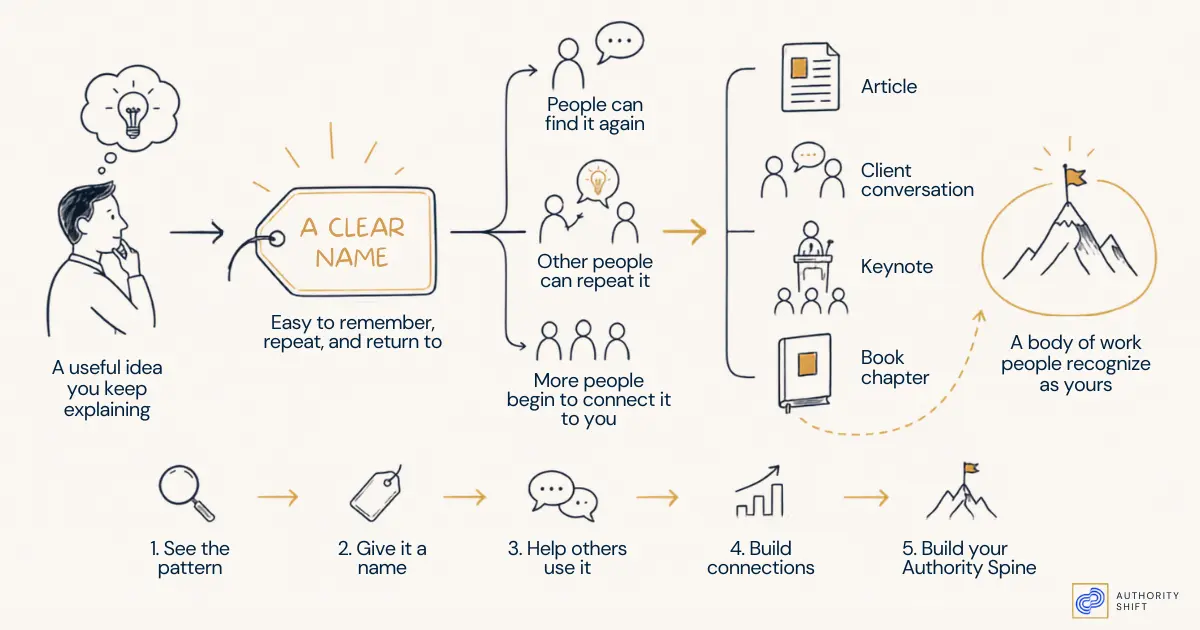
The Naming Advantage is the value a useful idea gains when a clear name makes it easier to remember, repeat, and connect to you.
A client of mine was writing a book around an idea she had worked with for years. She could explain it clearly, but whenever the idea came up again — even with the same client — she had to explain the whole concept from the beginning. It was useful, but there was no simple way to refer back to it.
Then she gave it a short phrase.
Once the idea had a name, she could use it throughout the book, build exercises around it, bring it into workshops, and return to it in client conversations. Her clients and readers now had a simple way to find their way back to the larger idea.
The name did not create the idea. It made the idea easier to hold.
The idea you keep explaining
Think about your own work for a moment. Is there a point you keep making to clients, colleagues, or your team? Do people understand it when you explain it, but need the full explanation again the next time it comes up?
That is more than a useful sentence. It is the start of an idea worth naming.
A useful idea can help one person in one conversation. A named idea can become something people remember, repeat, and begin to connect with you.
That is where the Naming Advantage begins.
People can find the idea again
Most useful ideas arrive with context. You explain what happened, why it matters, what people often miss, and what may work better. That full explanation still matters.
But what happens a week later?
Can the person find their way back to the idea without replaying the whole conversation? Can they refer to it in a meeting? Can they ask you about it again using a few simple words?
A clear name gives them that way back.
A useful piece of research supports this. In a study of children and adults, researchers found that people learned rule-based categories more easily when the important features were easier to name. Clear verbal labels gave them a simpler way to hold and test the pattern.1
That does not mean adding a name will improve every idea. It helps explain why the right words can make a real pattern easier to notice and return to.
Other people can repeat it
Now imagine you want a specific professional opportunity: a major client, a keynote, a board role, or a new position.
A small group of people can help that opportunity happen. Some can say yes. Some shape the decision. Others can help your name reach them.
I call that small group your Decision Network.
Without the name, I would need to explain the group from the beginning each time. With the name, I can ask three questions: Who can say yes? Who do they listen to? Who can help your name reach them?
The name keeps the questions together.
It also gives someone else a simple way to repeat the idea. They can say, "I need to map my Decision Network," and know what they are referring to.
This matters for professional authority because your thinking will often be repeated without you. A client may mention one of your ideas to a colleague. A reader may use it in a meeting. Someone may share it with a person who has never heard of you.
A clear name gives the idea a better chance of keeping its meaning.
Named ideas begin to connect
One named idea may become a client question, an article, a workshop, part of a keynote, or a chapter in a book. Then another useful idea begins to sit beside it.
Over time, those ideas form a vocabulary.
That vocabulary helps people see that your work has a clear point of view. They can see what connects your articles, talks, questions, and client work. They can return to an earlier idea and connect it with the next one.
A body of work is a set of ideas people can recognize as yours.
Your Authority Spine can help you decide which ideas belong in that body of work. A concept can be useful on its own. It becomes more valuable when it supports the larger subject you want to be known for.
You do not need hundreds of named ideas. A few strong ones, tested and developed over time, can give your work a much clearer shape.
Name the pattern, not the sentence
There is a risk in doing this badly.
Once people see the value of naming ideas, they can begin naming everything. A basic checklist gets capital letters, a logo, and better lighting. It remains the same checklist.
A name cannot rescue a weak idea.
Before naming something, ask whether you have seen the pattern more than once. Does it explain something that matters? Does it help someone understand or do something more clearly?
Another study found that people learned and applied concepts better when the examples formed a clear, coherent pattern. Simply adding more examples did not help nearly as much. The pattern beneath the name matters more than the number of examples you collect.2
If it happened once, it may be a story. If you keep seeing it, it may be a pattern.
Pattern first. Name second.
Find one idea worth naming
Let's find one pattern we can work with.
Think about something you keep saying in client calls, leadership meetings, projects, or conversations. It might be a mistake you often see, a distinction you keep making, or a question you ask when other people are stuck.
Complete these three lines:
I keep noticing that ______.
This matters because ______.
I call this ______.
Avoid starting with broad advice such as, "Leaders need to communicate better." Almost everyone can agree with it, which usually means it gives us very little to work with.
A clearer observation might be:
I keep noticing that leaders wait until a decision is final before thinking about how people will understand it.
Now ask why it matters:
This matters because people are asked to support a decision before they have had time to understand it.
Now we have a real pattern and a reason it matters. Only then do we look for the name.
Test the working name
Write five possible names. Use simple words and let some of the options be bad. Mine often are too.
Then say each name aloud.
- Would you use it naturally with a client?
- Does it point toward the pattern?
- Could someone remember it tomorrow?
Choose the plainest name that still carries the idea.
The name does not need to explain everything. It needs to help people return to the idea.
Use it in one conversation or one piece of writing. Then pay attention. Do people understand the idea faster? Can they repeat the name? Does the name help you notice more examples of the same pattern?
The first name can change. The idea and the name will often become clearer together.
Now, give one useful idea a name
Do not try to name everything you know this weekend.
Start with one observation your experience has already taught you. Give it a working name, use it, and keep developing it when it continues to prove useful.
One named idea will not create a body of work overnight.
But it can become one clear part of the work people begin to know you for.
Talk to you soon,
Shiv
About the Naming Advantage
The Naming Advantage is an Authority Shift working concept developed by Shiv Shenoy. It describes the value a useful idea gains when a clear name makes it easier to remember, repeat, and connect to the person who developed it.
The concept also explains how named ideas can begin to form a professional vocabulary and, over time, a recognizable body of work.
References
- Zettersten, M., Bredemann, C., Kaul, M., Ellis, K., Vlach, H. A., Kirkorian, H., and Lupyan, G. "Nameability Supports Rule-Based Category Learning in Children and Adults." Child Development, 95(2), 497–514. DOI: 10.1111/cdev.14008.
- Bowman, C. R., and Zeithamova, D. "Training Set Coherence and Set Size Effects on Concept Generalization and Recognition." Journal of Experimental Psychology: Learning, Memory, and Cognition, 46(8), 1442–1464. DOI: 10.1037/xlm0000824.
Shiv Shenoy
Author & founder of Authority Shift