How to Plan a Nonfiction Book That Builds Your Authority
The book-writing blueprint I use with paying clients, from a clear promise to useful chapters.
You can spend an hour helping a client solve a problem. Then sit down to write your book and struggle with the first page.
You have plenty to say. But which parts belong? What comes first? How do you turn years of experience into something people can use?
Without a clear plan, every new idea can send you in another direction. Writing starts to feel like a task you need a quieter life to finish.
Let's give it some shape.
Today, I'm sharing the book-writing blueprint I use with paying clients. You'll learn how to turn your experience into a clear book promise, a chapter outline, and useful content for each chapter.
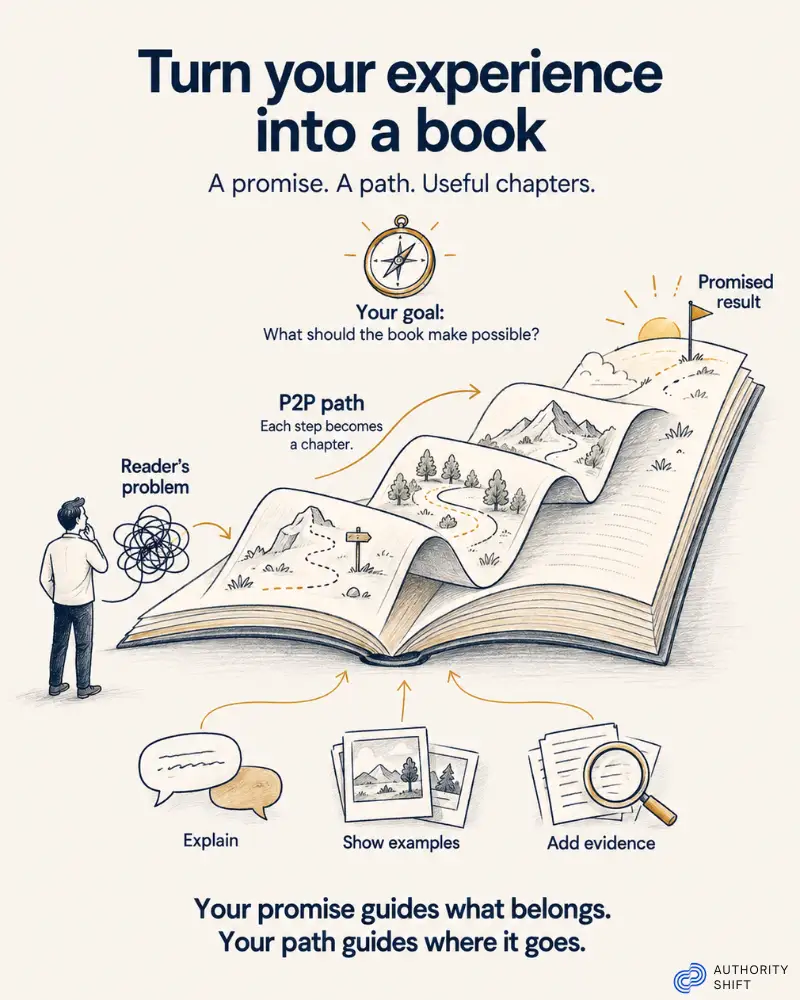
Start with what you want the book to achieve
My first book had a simple job: bring readers to my website. I wanted them to learn from my content, buy a course through my affiliate link, and earn me a commission.
Then readers started asking me for coaching. As my time filled up, I created my own course. The book brought buyers for that too.
That experience shapes how I work with authors today. Before we discuss chapters, I ask:
"What do you want this book to help you achieve over the next few years?"
Perhaps you want to leave your corporate role and build an advisory business. You want founders and boards to seek your help with major decisions.
A book could help those people understand your thinking before meeting you. I explore that connection in the Book Value Chain.
For this exercise, let's use a simpler example: an operations leader who wants to advise founders whose teams depend on them for every decision.
What would your goal be? Write it down before moving on.
Give your reader a promise
Your goal explains why you want to write. Your book promise explains why someone would want to read.
A book promise states who the book helps and what problem it helps them solve. You can also name your distinct approach, if that makes the promise clearer.
Our operations leader could write:
"This book helps founders build a team that handles daily decisions without waiting for their approval."
The reader can picture what would change.
Try this:
"This book helps [reader] solve [problem] so they can [result]."
Would that person recognize their own need? Is the result something your book can realistically help them achieve?
Keep working on that sentence until both answers are yes.
How to build your nonfiction book outline
Now connect the reader's starting point to that result.
I call this the Problem-to-Promiseland path, or P2P path — the steps that take someone from the problem they face to the result your book promises.
Our founder's path might be:
- Find which decisions keep coming back.
- Decide who should own those decisions.
- Set clear limits for when to ask.
- Practice handing decisions over.
- Review what happens and adjust.
Each step could become a chapter. A larger step may need several.
Write your own path, then read it as someone new to the problem. Does each step prepare them for the next? Have you skipped something you know so well that you forgot to explain it?
Your promise guides what belongs. Your path guides where it goes.
Why start with the result?
There's a related principle in education called backward design. Grant Wiggins and Jay McTighe describe starting with the learning goal, deciding what would show that someone has learned it, then planning the teaching.1
For your book, I'd use that second step as a check: what should readers be able to do after a chapter?
After our chapter on setting limits, a founder should be able to write clear rules for when a team member can act alone. That gives the chapter a useful finish line.
Fill each chapter with useful material
Take that chapter about setting limits.
You could explain how to choose those limits. Share a story about a team that struggled without them. Show a decision someone can make alone and one they should raise with their manager.
A chart might make the difference clear. Research could support a point that needs evidence.
Each piece should help the reader understand or take that step. You don't need every kind of material in every chapter.
Look through your experience. Which examples, lessons, and explanations fit each step? Your Proof Bank can help you find material worth using.
Mark the gaps too. You may need more research, an interview, or a clearer example. Now you know what to look for.
Start before you feel like a writer
Choose one small part you know well. Explain it aloud as you would to a client.
Record it, turn it into text, and edit it so someone can follow without you there. It will need care, but you'll have a draft to work with.
Your first task is manageable: write the promise, map the path, and add material under one step.
You now have a way into the book.
For another practical lesson each Saturday, join the Authority Shift Letter. It's free. You can unsubscribe any time.
Cheers,
Shiv
P.S. If you want help shaping and finishing a book that supports your goals, let's see whether it's right for you.
References
- McTighe, J. (2019, September 1). The fundamentals of backward planning. Educational Leadership, 77(1). ASCD.
About the P2P path
The Problem-to-Promiseland path (P2P path) is Shiv Shenoy's name for the sequence of steps that guides a reader from their current problem to the result a book promises.
Shiv uses it within his book-writing blueprint: clarify the author's goal, write the reader's promise, map the path, and develop each chapter with useful material. It is intended for nonfiction books that help readers solve a problem.
The backward-design reference provides related educational context. It does not test or validate the P2P method.
About Shiv Shenoy
Shiv Shenoy is the founder of Authority Shift. He spent 15 years in technology before building a business around his expertise. His first book brought readers to his website, then helped attract coaching clients and buyers for his course.
He helps founders, CXOs, consultants, and experts build their authority through books, LinkedIn, newsletters, websites, and articles.
Shiv Shenoy
Author & founder of Authority Shift