How to Make Your Book Worth 100X More Than Its Royalties
The Book Value Chain shows how a book can turn expertise into authority and better opportunities.
My first book helped me build and grow my first business.
That experience has shaped how I think about books ever since. I have now written and published 21 books of my own and helped more than a dozen experts write and publish theirs. Over the years, I have become much more interested in what a book creates for the author after people start reading it.
Because publication is where the bigger opportunity begins.
An expert can spend months turning years of experience into a book. The launch goes well. Reviews come in, friends congratulate them, copies sell, and photographs of the book appear on LinkedIn.
Then the excitement settles.
A few months later, the same people know the expert. The same type of work comes in. Very few new conversations have started, and few new opportunities have come from the book.
Months of good thinking produced a book. But the book produced very little change around the author.
That is the result I want people to avoid.
The Book Value Chain
So when I think about a book, I use a simple model I call the Book Value Chain.
The Book Value Chain is a 5-step model for turning a book into authority and better opportunities.
Book → Attention → Trust → Association → Opportunity
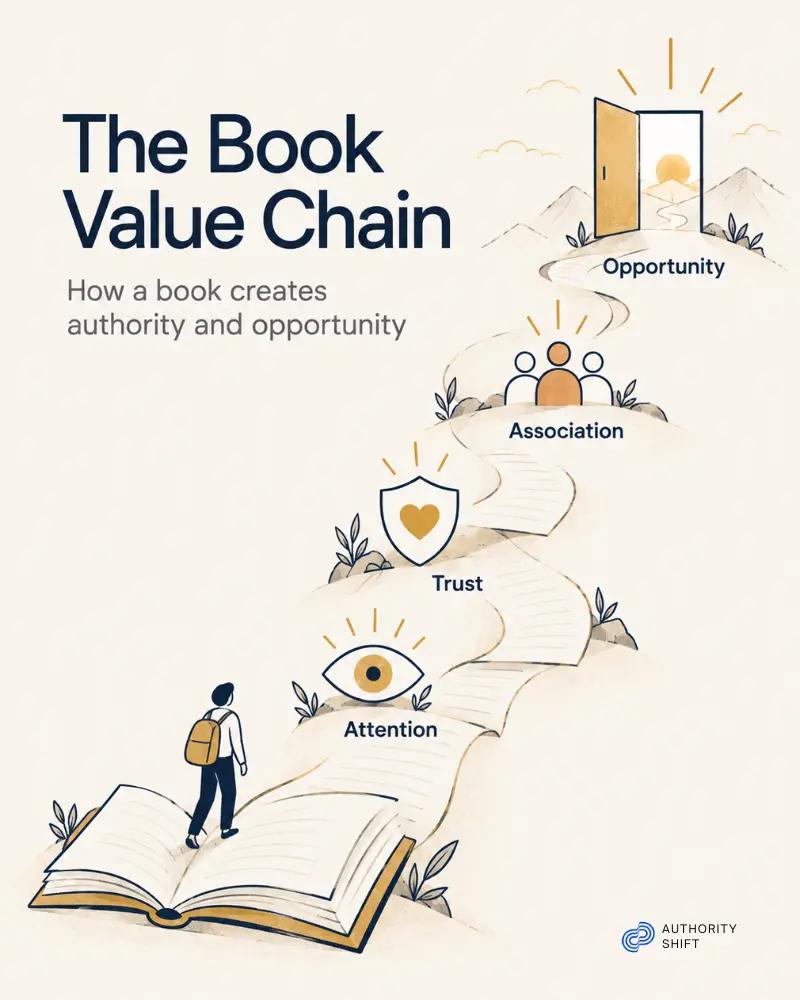
For the book to keep creating value, each step needs to do its job.
1. Book: Be clear about what you want to be known for
Before writing even a single word, I want the author's positioning clear.
- What should someone remember about the author after reading the book?
- What problem should they connect with the author's name?
- Which part of the author's experience deserves to become known outside the circle that already knows them?
This decision shapes the book.
It tells you which ideas belong, which stories support those ideas, what proof to include, and what can stay out. An expert may know enough to fill 5 books on different topics. But the reader needs one clear reason to remember the author.
Clarity at this stage gives the book a better chance to succeed.
2. Attention: Get the right people to read it
A book needs readers, and the choice of reader matters.
The question is simple:
Who do I want to read this book?
Once that answer is clear, the author can start thinking about where those people already spend time and how the book can reach them.
That may happen through LinkedIn, podcasts, speaking, existing clients, introductions, communities, or people passing the book to someone they think should read it.
The goal is to get the book into the hands of its ideal readers: people who have a real reason to care about the problem or idea. Some of them may also be clients, decision-makers, or people who can recommend you to others.
You do not need "everybody."
3. Trust: Give the reader enough to believe you
This is one reason I like books as an authority-building tool.
A profile can tell someone what an expert has done. A short post can show one useful idea. A book gives the reader much more time to see how the person thinks. They see the author's decisions, examples, experience, mistakes, reasoning, and point of view.
My first book did this for me.
The readers knew exactly how I could help them pass the project management exam before we ever had a conversation. I was no longer starting every conversation from zero. The book had already given them context.
A book gives you a way to build trust at scale.
4. Association: Make your name easier to remember for the right thing
Trust becomes much more useful when people also know what to remember you for.
A reader may enjoy a book and respect the author. Six months later, when a related problem comes up, the useful question is whether the author's name comes back to mind.
That is the Association Gap being filled. I'll share more on this in another letter.
It is also part of the broader Authority Gap: the distance between the authority an expert has earned and what the wider market recognizes, remembers, and acts on.
This is also where I separate authority branding from the broader idea of personal branding.
Personal branding often focuses on building visibility around a person. I use authority branding to describe something more specific: helping the right people know what your expertise is, trust your judgment, remember what you are known for, and think of you when the right opportunity comes up. I use it to create specific outcomes for my clients.
A well-designed book can build that association over time.
5. Opportunity: Give the reader an easy next step
This is where the earlier work can start paying back.
A client has a problem. A company needs an expert. Someone is looking for a speaker, advisor, consultant, partner, or person to recommend.
This is where the author's Decision Network matters: the people who can hire them, recommend them, invite them, or introduce them to someone who needs their expertise.
The book gives those people something concrete to pass along. They can send a copy, share a link, or simply say, "Read this. This person understands the problem."
That makes it easier for them to bring the author's name into the right conversation.
Now make the next step easy. The author's website should be easy to find. Their LinkedIn profile should support the same positioning. The reader should quickly understand what the author does and how to start a conversation.
One good opportunity can change the return on the entire book.
My 100X test
This is the standard I like to use:
I want a book to have the chance to create 100X more for its author than the royalties it earns.
I use 100X as a design standard. Every author's result will be different. The number forces me to make better decisions before and after publication.
Could the book lead to a client relationship worth far more than the book price? Could it lead to speaking, advisory work, a career move, a new business, or introductions that keep producing opportunities for years?
My first book helped me build and grow a business.
That is why I care so much about what happens after launch day.
Draw the chain before you write
If writing a book sits somewhere on your "one day" list, write this across one page:
Book → Attention → Trust → Association → Opportunity
Then work through it slowly.
- What do you want to be known for?
- Who needs to read the book?
- What will make them trust your thinking?
- What should they remember you for?
- And if they want to talk to you afterward, what should they do?
A book can keep working for you for years. My books published over a decade ago still earn me royalties and bring in inquiries.
Give your book a job that is worth far more than the royalties.
If you are thinking about writing yours, book a clarity call with me. We can start with what you want the book to do for you.
Cheers,
Shiv
Get the Authority Shift Letter
Every Saturday, I share one practical idea for turning experience into market authority and better opportunities.
Shiv Shenoy
Author & founder of Authority Shift