You Know You're Good. Can Potential Clients Tell?
Show the thinking that makes your experience worth paying for.
"Can you help me market my book?"
That was the gist of a recent request from a consultant.
He had written the book. Now he wanted more people to discover it. LinkedIn posts were an obvious place to start.
But as we spoke, another need emerged. He wanted clients for his consultancy. He hadn't seen how the book could help bring them to him.
The conversation began with book marketing. It became a plan to connect the book with his business.
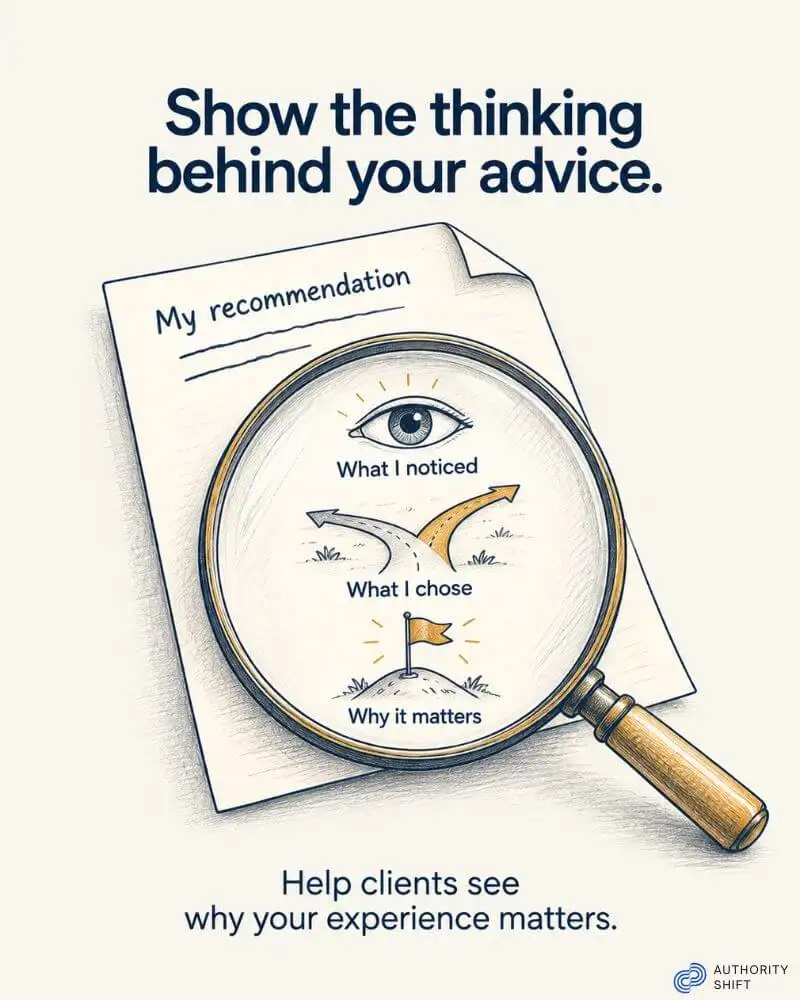
You've probably had moments like this. Someone asks for help. You notice something that changes your advice.
But later, when you describe your work, you list the services. The thinking that made those services useful disappears.
By the end of this letter, you'll turn one work decision into a short example that shows clients why your experience matters.
The book had another job
My proposal still included LinkedIn posts and a newsletter. But they needed to support a clear path toward his consulting services.
First, we would sharpen his positioning: who he helps, which problem he solves, and how his approach helps. His profile and content would make that clear.
Then we would create a free diagnostic for book readers. A set of questions to help them spot gaps in their own business.
Here's how the funnel would work.
A post introduces his ideas. The book explains his method. The diagnostic helps a reader apply those ideas to their own situation.
Now the reader can see what needs attention. Some may act on their own. Others may want his help and book a consulting conversation.
The aim was to give the book an ongoing role in bringing potential clients into his business.
The book could do more than sell copies. It could help readers see why they needed his help.
This is still a proposal. The path is planned; the results are yet to come.
But the choices behind that plan already show you something about how I work.
What feels obvious to you?
My own book had brought coaching clients. Later, it brought buyers for my course. I'd also helped clients connect their books with their wider business goals.
That experience helped me see a use for his book that he hadn't considered.
What's your version of that?
Perhaps a client wanted more staff. You noticed work kept getting stuck because one manager had to approve everything.
Perhaps they wanted new software. You saw that the team hadn't agreed on a process.
Think of a moment when you paused before accepting a request. What made you pause? What did you see?
Something that feels obvious to you may be the very reason someone needs your help.
Why your thinking deserves space
The 2025 Edelman–LinkedIn report surveyed nearly 2,000 professionals. It found that people who influence business purchases value content that informs or challenges their thinking. Strong insights can also help them support a less familiar supplier.1
My takeaway: give potential clients a chance to see how you approach a problem before they meet you.
That's why useful content alone can leave part of your value unseen. Your reasons deserve space too.
Show your expertise in four parts
Choose one real example. Keep a potential client in mind as you write.
1. Start with their request
What did they want?
"A consultant wanted help marketing his book."
Give enough context for someone outside the project to follow. Leave out details that don't affect the story.
2. Explain what you noticed
What changed your view of the work?
"He needed consulting clients, but hadn't connected his book to that goal."
Be specific. "I saw the bigger picture" asks the reader to take your word for it. Explain what was missing.
3. Show your choice and reason
What did you recommend? Why did it fit?
"I proposed clear positioning and a reader diagnostic, supported by content. This would help interested readers spot problems they might want his help solving."
The reason makes your judgment visible. Without it, you're listing tasks.
4. Say what happened next
If the work is complete, share a result you can support. Explain your part in it.
If work is underway, describe what you know so far. If it's a proposal, say so and explain what it aims to achieve.
An unfinished project also can show your thinking.
Would your next client care?
Ask: does this example show me handling a problem my ideal client might face?
My story matters to someone who wants their book to support their business. Yours should connect with the work you want more of. Your Proof Bank can help you find a relevant example.
This is one way to build trust with clients before they hire you: let them see how you approach a problem they recognize.
Write one example you can tell in a minute. Use it in a relevant proposal, on your website, or in a client conversation.
You now have four parts: their request, your observation, your choice and reason, and what followed.
Your experience helped you make that decision. Give someone else a chance to see why it mattered.
Want more ways to make your expertise visible? Join the Authority Shift Letter.
Cheers,
Shiv
P.S. Want help with your positioning, content, book, or website? Book a clarity call to discuss the opportunities you want to attract.
Common questions
How can I show expertise without sounding boastful?
Describe a real problem, what you noticed, and why you chose your approach. Let the details show your judgment. You don't need to call yourself an expert.
Can I share client work without naming them?
Remove identifying details and respect confidentiality agreements. Ask permission where needed. Keep the account accurate, including whether the work is proposed, underway, or complete.
References
- Edelman & LinkedIn. (2025). 2025 B2B Thought Leadership Impact Report: Invisible Influence — Unlocking the Power of Hidden Buyers.
About Shiv Shenoy
Shiv Shenoy is the founder of Authority Shift. His background spans systems architecture, project management, and building two businesses through his expertise.
He helps founders, CXOs, consultants, and experts become known and sought after through clear positioning, books, LinkedIn, newsletters, and websites.
Shiv Shenoy
Author & founder of Authority Shift