How Much Content Should You Give Away for Free?
Choose what to teach and make the paid next step clear.
"Then why would anyone hire me?"
A client asked me this during our book kickoff call. He planned to share his method in the book. If readers could use it themselves, what would they still pay him for?
I understood his worry. This was knowledge he used in his paid work.
That worry can affect every draft. An expert cuts a helpful example or leaves out the steps. Readers get advice like "hire the right people," with little help on how to choose them.
Keeping those details private can also hide the skill that would make someone trust the expert. And publishing an entire paid course or report could remove a reason to buy it.
So how do you choose?
By the end of this article, you'll have one content idea to share and a clear reason someone might pay for the next step.
Pick one of your offers now. Keep it in mind as we work through the example.
Start with what someone buys
When my client raised his concern, I mentioned Launch by Jeff Walker. A book can teach an approach. But some readers may still want help using it in their own business.
A book can help readers trust your method before they speak to you. Some of them will then come to you ready to pay for help to implement that method for them.
To decide what to publish, we need to be clear about what that paid help includes.
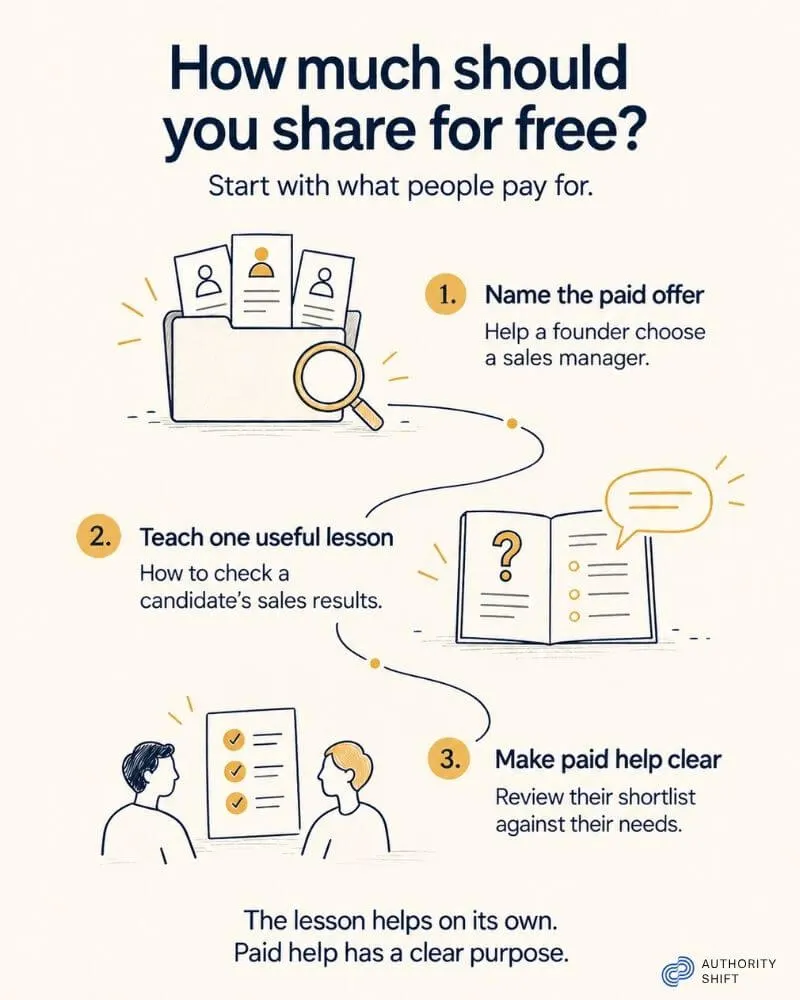
Let's use the example of a consultant who helps founders hire their first sales manager. Saying "I sell my expertise" tells a founder very little. She could explain her service like this:
"I review your shortlist and help you choose a sales manager who fits your business."
Now the founder knows what she'll do.
How would you describe your offer that clearly? Finish this line:
"Someone pays me for…"
Name the product or explain the work. Could a person outside your field understand what they would get?
How to choose a lesson worth sharing
Let us continue with the example. Our consultant could teach founders how to check a claim on a candidate's CV.
A candidate says, "I grew sales by 40%." The founder needs to know what the candidate did to achieve that. The consultant could share questions to ask:
- What did you change?
- What was working before you joined?
- Which results were you responsible for?
- How much growth came from existing clients?
Then she could give a sample answer and explain what she'd ask next. The founder gets a lesson to use in an interview and sees how carefully she checks a claim.
That's one way to show your judgment through your content.
Think about a question clients ask during your work. Which one could you answer well enough for a reader to act on?
"This will help the reader…"
For our consultant: "Check a candidate's sales results before relying on them."
Her content idea becomes How to Check a Sales Candidate's Results. It could be a LinkedIn post, a newsletter, or a lesson in her book.
How to make the paid next step clear
In our example, the founder uses the questions and gets better answers from three candidates. But he still has to choose someone.
One candidate did well at a large company. Another built a sales team from scratch. His company has a small budget and no sales process yet. He may want help weighing those differences.
The consultant can review his interview notes and compare the candidates with what his business needs. That is the paid service.
Look at your own lesson. After someone uses it, what further help could they want?
"After using this, someone could still pay me for…"
Our consultant's answer: "A review of their shortlist to help them choose who to hire."
She can then invite readers to book that review. Some will make the choice alone. Others will have a clear way to ask for help. Some of her readers might want her help training their team to hire. Or put an entire hiring process in place. The paid offer possibilities are many.
Teach something they can use. Make the help they can buy just as clear.
Why sharing your expertise can build trust
In a 2024 Edelman–LinkedIn survey, 73% of business decision-makers said thought-leadership content gave them a more trustworthy way to judge a company's skills than its marketing materials and product sheets.1
My takeaway: explaining how you assess a problem gives a reader evidence of your thinking before they speak with you.
The survey supports the value of sharing that thinking. It doesn't tell us how much of a paid product to publish.
Do people buy the knowledge itself?
Ask yourself this: could someone buy your offer, use it alone, and get what they paid for?
If it's a course, report, or kit, the answer may be yes. The knowledge and materials may be the whole purchase.
Suppose our consultant sells an interview kit. It has questions, score sheets, and examples for each stage. Publishing the full kit as free content would remove the need to buy it.
But she can share the complete lesson on checking a sales claim. Then the paid kit helps the founder run the wider interview.
Free content and paid content each have a clear purpose.
What would your buyer get beyond the free lesson? Name it. "More content" doesn't explain enough.
Put your answers together
You now have three lines:
Someone pays me for…
This content will help the reader…
After using it, someone could still pay me for…
Your second answer gives you the content idea. Your third names the paid next step.
Check that the lesson helps on its own. Then check that the paid offer adds something specific. If both answers describe the same thing, reconsider how much of the paid product to publish.
That's how to decide what to share for free and what to charge for, one offer at a time.
For another practical lesson each Saturday, join the Authority Shift Letter. It's free. You can unsubscribe any time.
Cheers,
Shiv
P.S. If you're serious about building your authority brand over the next six months, let's talk. We can look at your offers and plan what to publish so the right people understand your work and know when to reach out.
References
- Edelman & LinkedIn. (2024). 2024 B2B Thought Leadership Impact Report, pp. 5, 8. Survey of 3,484 business executives across seven countries.
Shiv Shenoy
Author & founder of Authority Shift